1863 Fourth Issue 10 Cent Fractional Note - Choice Very Fine (VF+) - Large Red Seal Type - 1863 4th Issue Ten Cent Fractional Note - Fr 1258
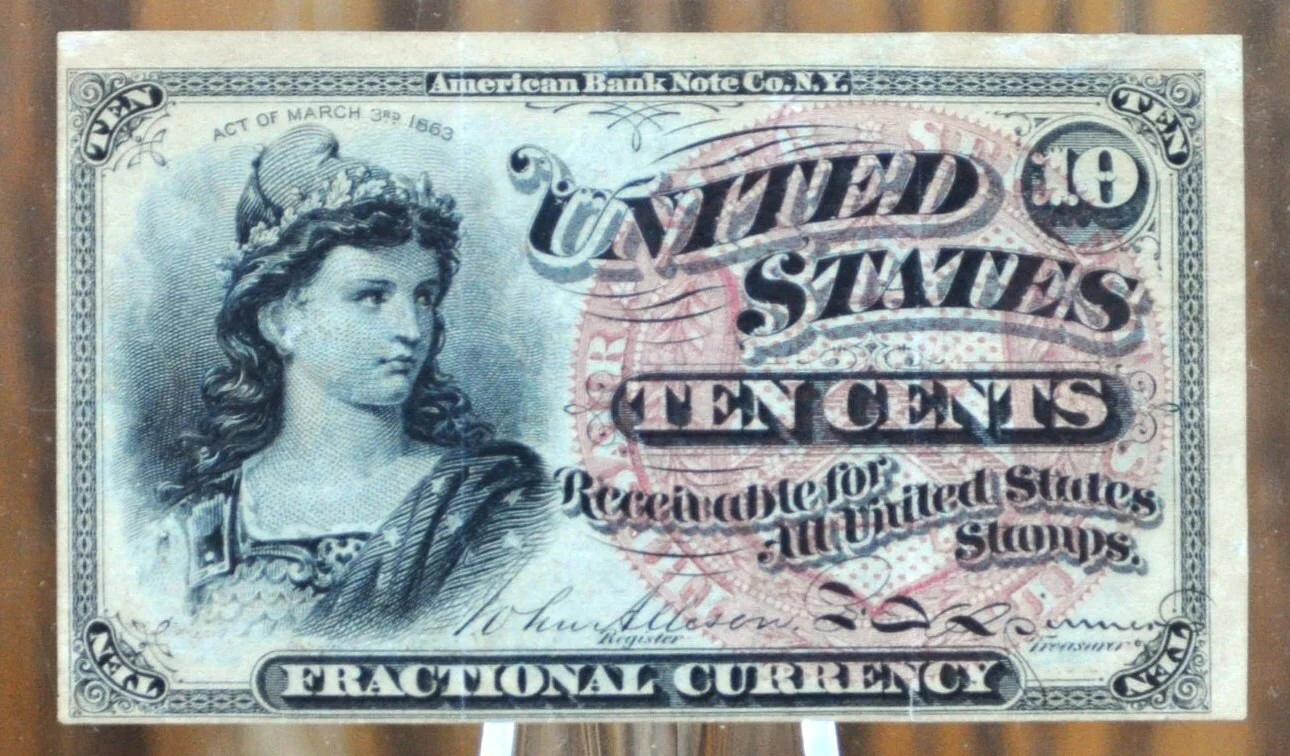
1863 Fourth Issue 10 Cent Fractional Note - Choice Very Fine (VF+) - Large Red Seal Type - 1863 4th Issue Ten Cent Fractional Note - Fr 1258
This listing is for the photographed 1863 10 Cent Fractional Note. 4th Issue, Friedberg Number 1258. These notes have a large red seal on the right end, differentiating it from other issues. Note is printed on unwatermarked paper with pink silk fibers. Choice of grade/condition. Choice Very Fine (VF+) with tears in the corners available. Great note for a collection.
Some history below the note specifics, these notes were issued during the Civil War.
Note Specifics:
- Friedberg Number 1258 (Fr#1258)
- Series: Fourth Issue
- Government Signatures: Allison-Spinner
- Large red seal
- No watermark
Very cool note.
The Civil War economy catalyzed a shortage of United States coinage; gold and silver coins were hoarded given their intrinsic value relative to irredeemable paper currency at the time. In late 1861, to help finance the Civil War, the U.S. government borrowed gold coin from New York City banks in exchange for Seven-thirties treasury notes and the New York banks sold them to the public for gold to repay the loan.
In December 1861, the Trent Affair shook public confidence with the threat of war on a second front. The United States Department of the Treasury suspended specie payments and banks in New York City stopped redeeming paper money for gold and silver. In the absence of gold and silver coin, the premium for specie began to devalue paper currency. After the New York banks suspended specie payments (quickly followed by Boston and Philadelphia) the premium on gold rose from 1–3% over paper in early January 1862 to 9% over paper in June 1862, by which time one paper dollar was worth 91.69 cents in gold. This fueled currency speculation and created significant disruption across businesses and trade. Alternate methods of providing small change included the reintroduction of Spanish quarter dollars in Philadelphia, cutting dollar bills in quarters or halves, refusing to provide change (without charging a premium for providing silver coins), or the issuance of locally issued shinplasters (i.e., those issued by businesses or local municipalities), which was forbidden by law in many states.
Treasurer of the United States Francis E. Spinner has been credited with finding the solution to the shortage of coinage: he created postage currency (which led into the use of fractional currency). Postage (or postal) currency was the first of five issues of US Post Office fractional paper money printed in 5-cent, 10-cent, 25-cent, and 50-cent denominations and issued from 21 August 1862 through 27 May 1863. Spinner proposed using postage stamps, affixed to Treasury paper, with his signature on the bottom. Based on this initiative, Congress supported a temporary solution involving fractional currency and on 17 July 1862 President Lincoln signed the Postage Currency Bill into law. The intent, however, was not that stamps should be a circulating currency.
Authentic 10 Cent Fourth Issue Fractional Note Fr#1258 - AU (About Unc.) 1863 Fractional Money, 4th Issue Ten Cent Fractional Fr1258
Original: $73.00
-65%$73.00
$25.55Product Information
Product Information
Shipping & Returns
Shipping & Returns
Description
This listing is for the photographed 1863 10 Cent Fractional Note. 4th Issue, Friedberg Number 1258. These notes have a large red seal on the right end, differentiating it from other issues. Note is printed on unwatermarked paper with pink silk fibers. Choice of grade/condition. Choice Very Fine (VF+) with tears in the corners available. Great note for a collection.
Some history below the note specifics, these notes were issued during the Civil War.
Note Specifics:
- Friedberg Number 1258 (Fr#1258)
- Series: Fourth Issue
- Government Signatures: Allison-Spinner
- Large red seal
- No watermark
Very cool note.
The Civil War economy catalyzed a shortage of United States coinage; gold and silver coins were hoarded given their intrinsic value relative to irredeemable paper currency at the time. In late 1861, to help finance the Civil War, the U.S. government borrowed gold coin from New York City banks in exchange for Seven-thirties treasury notes and the New York banks sold them to the public for gold to repay the loan.
In December 1861, the Trent Affair shook public confidence with the threat of war on a second front. The United States Department of the Treasury suspended specie payments and banks in New York City stopped redeeming paper money for gold and silver. In the absence of gold and silver coin, the premium for specie began to devalue paper currency. After the New York banks suspended specie payments (quickly followed by Boston and Philadelphia) the premium on gold rose from 1–3% over paper in early January 1862 to 9% over paper in June 1862, by which time one paper dollar was worth 91.69 cents in gold. This fueled currency speculation and created significant disruption across businesses and trade. Alternate methods of providing small change included the reintroduction of Spanish quarter dollars in Philadelphia, cutting dollar bills in quarters or halves, refusing to provide change (without charging a premium for providing silver coins), or the issuance of locally issued shinplasters (i.e., those issued by businesses or local municipalities), which was forbidden by law in many states.
Treasurer of the United States Francis E. Spinner has been credited with finding the solution to the shortage of coinage: he created postage currency (which led into the use of fractional currency). Postage (or postal) currency was the first of five issues of US Post Office fractional paper money printed in 5-cent, 10-cent, 25-cent, and 50-cent denominations and issued from 21 August 1862 through 27 May 1863. Spinner proposed using postage stamps, affixed to Treasury paper, with his signature on the bottom. Based on this initiative, Congress supported a temporary solution involving fractional currency and on 17 July 1862 President Lincoln signed the Postage Currency Bill into law. The intent, however, was not that stamps should be a circulating currency.
Authentic 10 Cent Fourth Issue Fractional Note Fr#1258 - AU (About Unc.) 1863 Fractional Money, 4th Issue Ten Cent Fractional Fr1258